

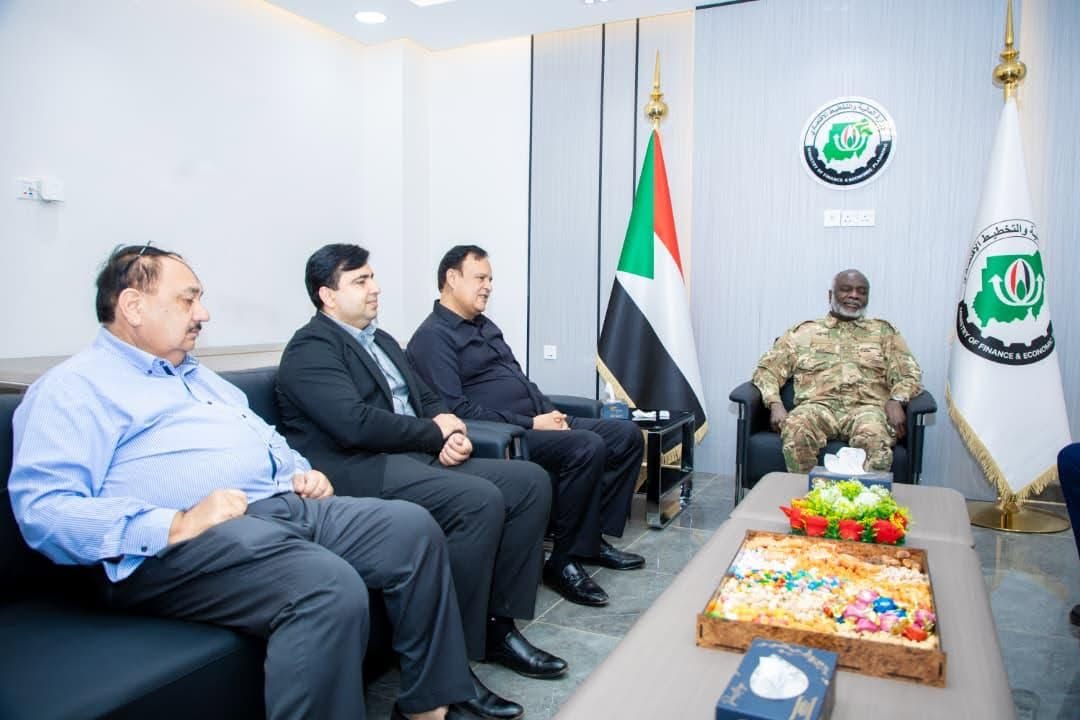
Khartoum (Lamaane.net) - Pakistani business delegation operating in Saudi Arabia on Tuesday, June 16, met Sudanese Finance Minister Jibril Ibrahim in Khartoum to explore investment opportunities in agriculture, livestock, mining, and electrical industries.
The meeting, held at the Ministry of Finance headquarters, brought together senior Sudanese officials and members of the visiting delegation, who outlined preliminary proposals aimed at expanding private sector participation in key productive sectors amid Sudan’s ongoing economic recovery efforts.
Discussions also touched on agricultural value chains, mineral processing, and electrical infrastructure development. Observers noted a formal and structured atmosphere, with officials emphasizing investment facilitation and regulatory cooperation, while delegates reviewed briefing documents and project outlines.
Finance Minister Jibril Ibrahim said: "The government is committed to encouraging regional and international investment in productive sectors that strengthen the national economy and enhance export capacity.”
He added that priority areas include agricultural expansion, livestock development, mining operations, and energy-related industries, stressing that value addition remains central to improving Sudan’s export competitiveness and industrial resilience.
Head of the delegation, Shefqat, said: "We see significant potential in Sudan’s agricultural and mineral sectors, and we are particularly interested in establishing projects in gold refining and electrical manufacturing.” He noted the group’s existing investments across Saudi Arabia, Pakistan, the United Kingdom, and the United States.
A Khartoum-based economic analyst, speaking to Lamaane News Network on condition of attribution, said foreign investment interest reflects "a gradual return of investor confidence, though operational risks remain significant.”
Sudan’s economic strategy continues to prioritize revitalization of agriculture and mining as primary drivers of growth, particularly after prolonged disruptions to infrastructure and production capacity. Energy and electrical manufacturing are increasingly viewed as essential to rebuilding supply chains and supporting public services.
The engagement highlights Sudan’s efforts to diversify investment partnerships across Asia, the Middle East, and Western markets, as authorities seek to stabilize macroeconomic conditions and expand export revenues. Analysts say such engagements may contribute to foreign currency inflows, job creation, and improved industrial capacity if projects move beyond preliminary discussions.