

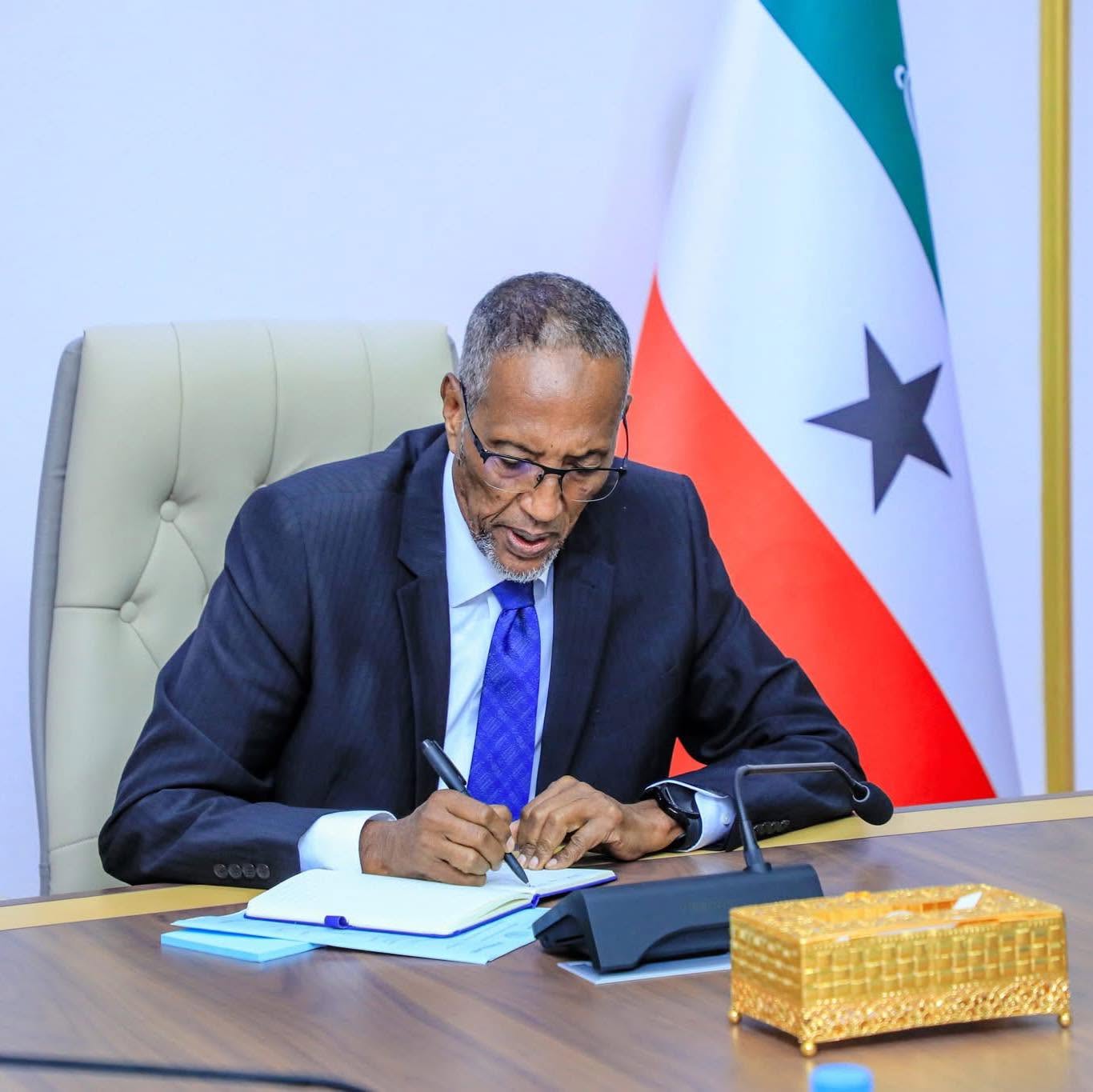
Hargeisa (Lamaane.net) - Muse Bihi Abdi, the former president of the self-declared Somaliland administration in the northwestern region of Somalia, said on Thursday, July 2, that he does not support or accept what he described as Israel's "illegal recognition" of the administration and accused incumbent President Abdirahman Mohamed Abdullahi (Irro) of misleading the public over contacts with Israel.
In a statement published on his official Facebook page on Thursday, Bihi responded to remarks he said Irro made during a meeting of the central committee of his political party. Bihi rejected claims that he had previously stated Somaliland had secured recognition from Guinea and Ethiopia, saying he had never declared that either country had formally recognized the administration.
"I have never said I obtained recognition from any government," Bihi wrote, accusing Abdirahman Irro of making false claims about his previous statements. He said recognition remains a primary objective for the self-declared Somaliland administration but insisted any development relating to that goal should be handled with caution and broad consultation to avoid creating political divisions.
Quoting remarks he said he delivered at the presidential palace in Hargeisa after reports of international recognition emerged, Bihi stated that recognition was important but should be assessed from multiple perspectives before political leaders reached a collective position. He also alleged that the presidency edited his speech before releasing it publicly and removed remarks delivered during the same event by former self-declared Somaliland administration President Dahir Rayale Kahin.
Muse Bihi further criticized Irro's conduct of foreign affairs, alleging that the current president had previously visited Israel without publicly disclosing the trip at the time. He claimed Irro later acknowledged making what he described as a secret visit, arguing that such an approach represented an unprecedented level of secrecy by a leader of the self-declared Somaliland administration.
The former president also questioned the handling of Irro's most recent overseas travel, saying the president spent several days in the United Arab Emirates before departing separately from members of his ministerial delegation, whom he said remained in Ethiopia before leaving independently. "Mr. President, what explains the secrecy and the separation?" Bihi asked in his statement.
Status of "Somaliland" in Northwestern Somalia
The entity calling itself "Somaliland” located in the northwestern region of Somalia, declared unilateral separation from Somalia in 1991 following the collapse of the central government of Somalia. It has since established its own governing institutions and administrative structures.
Despite its internal political arrangements, it remains unrecognized by any United Nations member state. The Federal Government of Somalia continues to assert sovereignty over the entire territory of the country, including the northwestern region where the separatist administration operates.
Most international institutions maintain recognition of Somalia’s territorial integrity within its federal framework. Within the northwestern region, seven major clans are widely reported to reside there, with six of them generally supporting national unity and opposing separatism, while one clan forms the primary support base of the separatist administration. Members of these communities, including those from the separatist clan, are also represented across federal institutions, including both houses of Parliament, the Judiciary, and other branches of the Federal Government of Somalia.
These institutional and social linkages reflect continued integration within Somalia’s national framework. Efforts toward unity, reconciliation, and state-building remain central to Somalia’s political process, with successive administrations emphasizing inclusive governance, power-sharing, and the strengthening of federal institutions as key pillars for long-term stability, national cohesion, and sovereignty.
Regional Significance
The Horn of Africa remains a strategically sensitive region marked by overlapping political, security, and economic challenges, including counterterrorism operations, maritime security concerns, and regional geopolitical competition.
Diplomatic analysts note that engagement with entities claiming independence within internationally recognized states often triggers broader disputes over recognition and sovereignty principles.
A regional affairs analyst based in East Africa, speaking generally, said such developments "test the balance between diplomatic engagement and respect for established international borders,” particularly in fragile or post-conflict states.
Broader international concerns have been raised regarding geopolitical stability in the Horn of Africa, a region located along critical global maritime corridors. The Red Sea and Gulf of Aden continue to play a vital role in international trade and energy transportation routes.
Maintaining Somalia’s territorial integrity is widely viewed as essential for sustaining regional stability and reinforcing international legal principles that uphold state sovereignty.