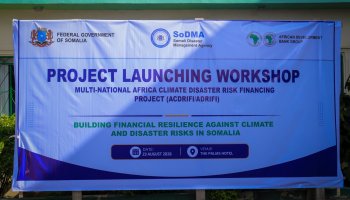


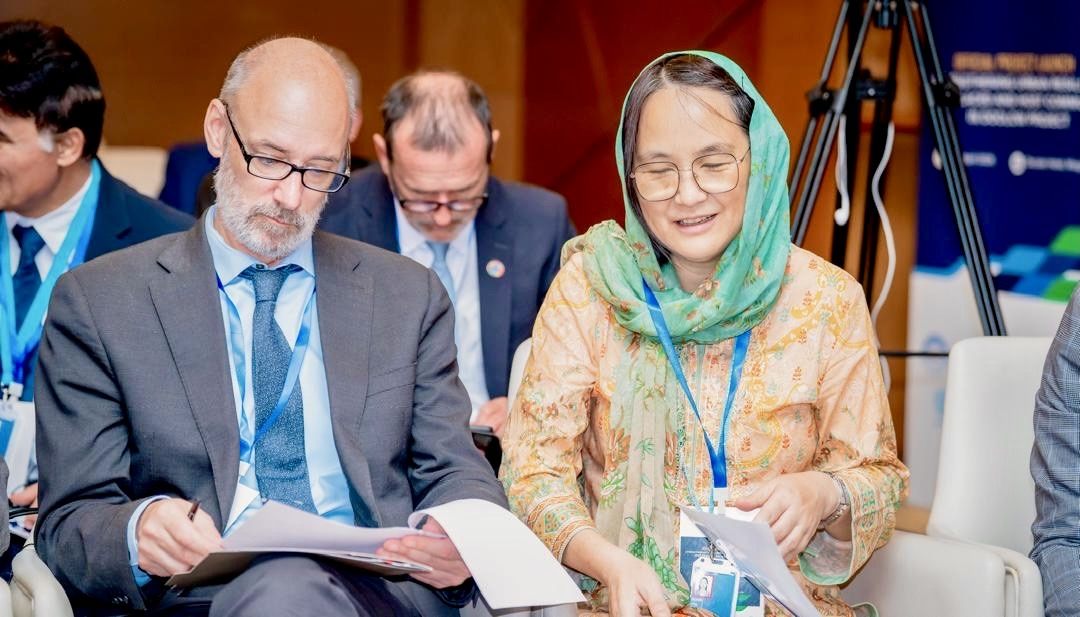
Mogadishu (Lamaane.net) – UN Refugee Agency (UNHCR), the Federal Government of Somalia, and the African Development Bank (AfDB) on Friday, 24 April launched a 20.55 million U.S. dollar urban resilience project aimed at improving conditions for internally displaced persons in Dollow town, Gedo region.
The initiative was formally announced during a coordinated ceremony in Mogadishu, where senior government officials and international partners endorsed a joint framework targeting durable solutions for displacement-affected communities across southern Somalia.
Officials from UNHCR, alongside representatives of the International Organization for Migration (IOM), the Food and Agriculture Organization (FAO), UN-Habitat, and UN Women, attended the event. The National Centre for Rural Development and Durable Solutions (NCRDS) was confirmed as the executing agency.
The project, titled "Strengthening Urban Resilience of Displaced and Host Communities in Dollow,” targets four urban IDP settlements. It focuses on improving basic infrastructure, expanding livelihood opportunities, and strengthening social cohesion between displaced populations and host communities.
"Beyond addressing immediate humanitarian needs, it is essential to invest in sustainable livelihoods and resilience,” said Ms. Jing Song, UNHCR Representative a.i. in Somalia. "Communities have clearly expressed their desire to move beyond aid dependency and rebuild their lives with dignity,” she added.
Somali Prime Minister Hamza Abdi Barre described the initiative as part of state-building efforts. "This project signifies a significant milestone in the Federal Government of Somalia's dedication to fostering durable solutions for internally displaced persons,” he said. "Durable solutions are not only a humanitarian imperative but a foundation for stability and inclusive development.”
Dr. Alex Mubiru, Director General for the African Development Bank’s East Africa regional office, said the initiative reflects a shift in displacement response strategy.
"This investment illustrates how Somalia is moving toward lasting outcomes through secure land tenure, climate-resilient housing, and livelihood opportunities for women and youth,” he said. He added that such efforts help transition communities "from fragility to stability and from vulnerability to dignity.”
Somalia currently hosts more than 3.9 million internally displaced persons, according to humanitarian estimates, making it one of the most affected countries in the region. Field-level observations during the launch highlighted continued pressure on urban services in displacement-affected areas, with aid workers noting overcrowding in informal settlements and limited access to clean water.
A humanitarian official, speaking to Lamaane News Network on condition of attribution, said coordination between development and humanitarian actors is increasingly critical as displacement becomes protracted rather than temporary. Analysts note that integrating infrastructure investment with governance reforms remains a central challenge for sustainable recovery.
The initiative forms part of broader African Development Bank support under its Transition Support Facility, emphasizing long-term resilience in the Horn of Africa. The project is expected to strengthen institutional capacity while promoting shared service delivery between displaced populations and host communities in southern Somalia.